Category: dev

  • It’s been a while!

    It’s been a while!

    Itโ€™s been a bit, hasn’t it? My last post went up around my birthday – though age is just a number until your back starts hurting, and life has been a total whirlwind ever since. Between the constant “life things” and navigating a few hurdles, I haven’t had much time to breathe, let alone write.

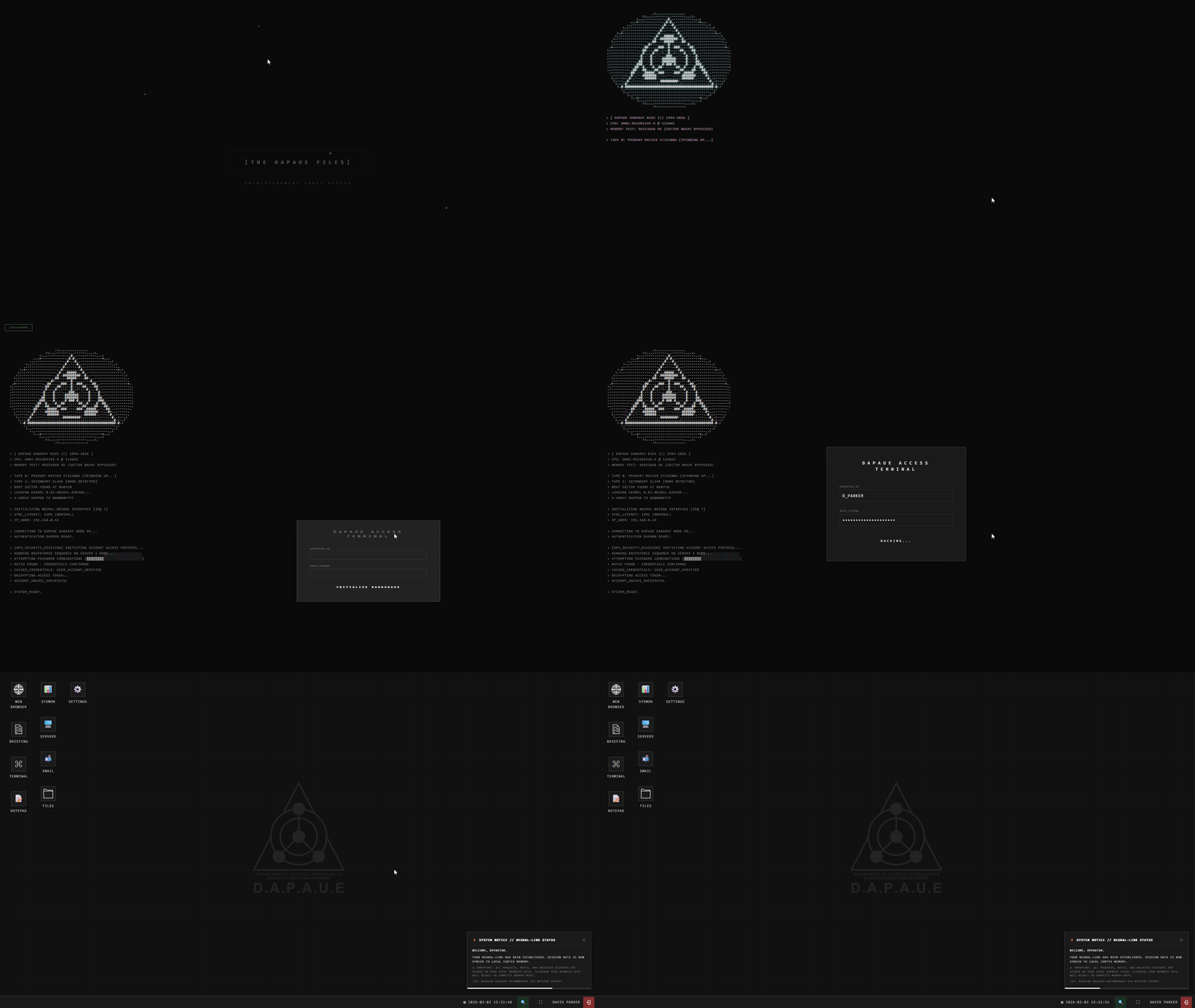
    The biggest update, however, is that Iโ€™ve finally made some massive breakthroughs with the game systems for DAPAUE, my detective project. Itโ€™s starting to feel like a real mystery now.

    As you can probably tell, the game looks completely different nowโ€”most notably, it’s officially moved into 3D. I started feeling like the “Investigative Desktop Sim” genre was getting a bit stale; there are so many variations popping up lately that the space really needs a fundamental shift. This is my attempt to shake things up.

    Inspired by the atmospheric storytelling of Gone Home and Virginia, DAPAUE casts you as a moderately respected agent sent to investigate a string of mysterious murders in a coastal Irish town. Youโ€™ll be:

    • Interacting with a cast of suspicious characters.
    • Collecting physical clues from the environment.
    • Connecting the threads on your own evidence board to uncover the truth.

    Iโ€™m aiming for a grounded, practical approach to detective work. That means zero hand-holding. Thereโ€™s no “ding” when you find the right answer; in fact, you won’t even know if youโ€™ve actually solved the case. Iโ€™m leaving that for the player community to debate and figure out together.


    Obsidian Plugin!

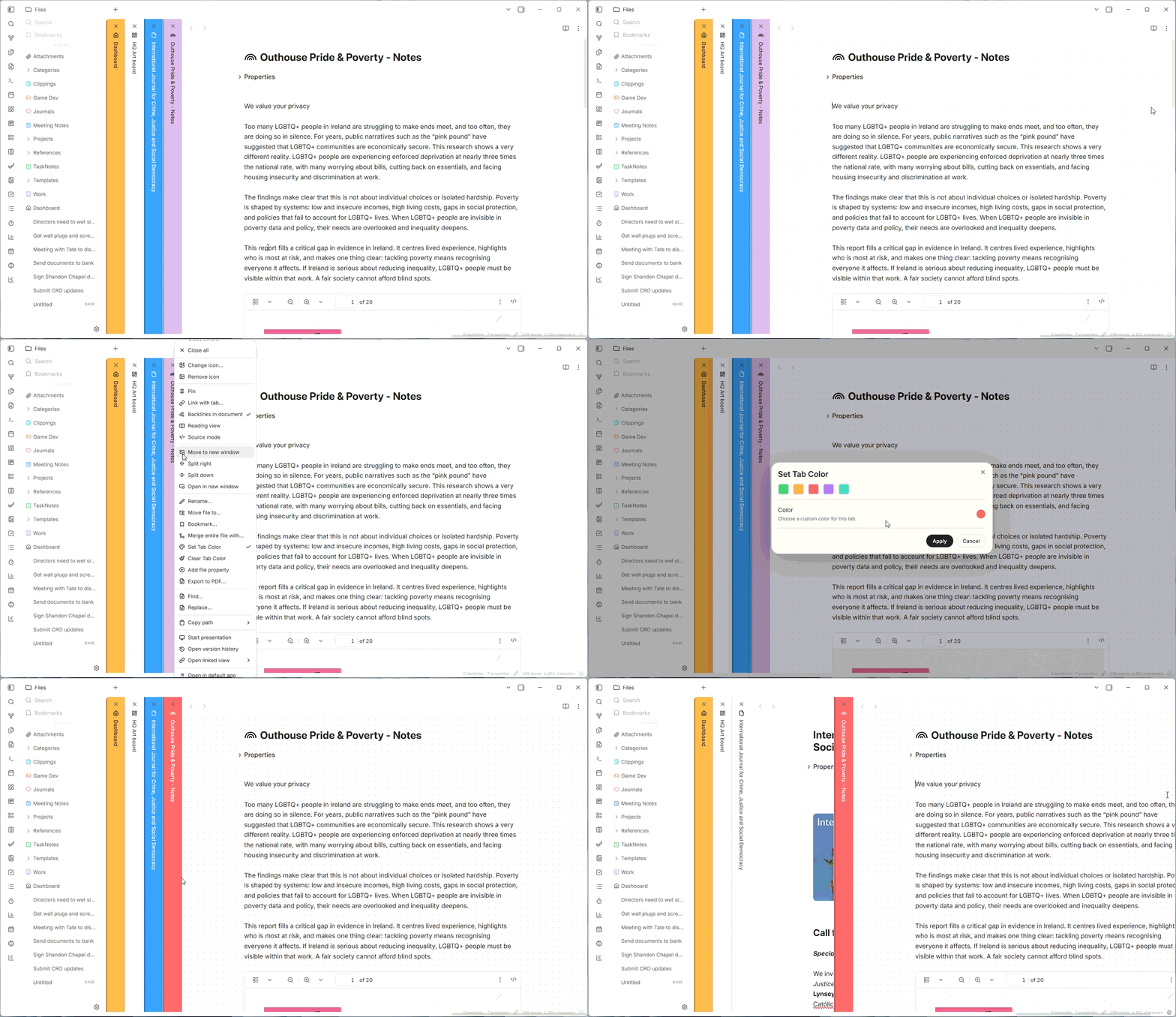
    In other news, I officially released my very first Obsidian plugin on GitHub today! Itโ€™s called Tab Colors, and it does exactly what youโ€™d expect: it lets you assign custom colors to your tabs.

    It does exactly as the name suggests. Let’s you assign a custom color to tabs!

    This started as a classic “I wish this existed” passion project. Iโ€™ve wanted this feature in Obsidian for ages. Inspired by the Adaptive Tab Bar Color, but wanting something more like OneNote where I can choose my own colors for tabs, I decided to try my hand at making one for Obsidian which happens to be my favorite notes app.

    Also it works in darkmode!

    Feel free to check it out and make some suggestions. I’ve already started working on some more features like tag assigned color, and some note background options.

    Hopefully will get into a better habit of updating this site, it’s suppose to be my personal version of social media, but I guess no social media is better than any social media.

    K

  • Dev Entry 02: // Big Swap to Godot

    So, if youโ€™ve been following the madness that is my attempt at building a game, youโ€™ll know I started out determined to do the whole thing in raw HTML5 and JavaScript. I was convinced I could build a working game just using the Canvas API.

    I was wrong. I was very, very wrong. But learned so much!

    HTML is great for a lot of things. If you want to make a website or a simple little puzzle game, youโ€™re sorted. But I was trying to build something with a bit of depth, specifically with state management, but as soon as I tried doing anything outside of direct interaction, it got difficult and to reliant on the user which isn’t efficient.

    I spent weeks just trying to get an asset to not jitter when the game would load, or not bork the entire log on experience because a core feature had a slight error. I was looking at thousands of lines of spaghetti code thinking trying to segment the then 13,000 line HTML file into modular JS scripts.

    I felt like I was trying to build a house with nothing but a spoon. You could do it, technically, but youโ€™d lose the will to live halfway through the foundation.

    Take it to the past few days.

    I wanted to add features HTML “can” but not adequately support. Game saves, dynamic animations, and possible 3D inclusion were things I wanted to add but HTML always felt that although it’s possible, it was incredibly janky!

    So I looked at the obvious, and decided to use a Game Engine. I had used many throughout the year to mess around with and learn, the first being the NetImmerse engine all the way back in 2003 when I was a die-hard Morrowind player. But more recently I had been looking at the GODOT engine,

    Godot Interface

    Godot is a Game Engine. A piece of software that handles all the heavy-lifting like maths, physics, rendering graphics – so you can focus on making or designing the level and systems. Itโ€™s also free (like free beer) and is open source with a passionate community behind it. You own what you make.

    The first thing that I found incredibly more efficient is the Node system. Instead of having one massive script file, everything is broken down into these tidy little scenes. You have a scene for your email system, a scene for the notifications, even a scene for the basic window system you see for image and 3D attachments. You just slot them together like Lego.

    And the scripting language is called GDScript. If youโ€™ve ever used Python, youโ€™ll be comfortable. Itโ€™s readable, with little if ever any need to have curly brackets everywhere or semicolons waiting to trip you up. You just write what you want the thing to do, and it does it.

    I rewrote an email mechanic that took me over a week with HTML and JavaScript but only about a single day in Godot. A day! I nearly cried.

    So anyway I’ve currently the email and files system completed alongside some creative decisions. Now I’m focusing on the evidence board concept.

  • Dev Entry: 01// DAPAUE_OS

    Dev Entry: 01// DAPAUE_OS

    Iโ€™ve been making steady progress on my latest project – a game played entirely through a simulated desktop interface. The core loop involves digging through the digital remains of a clandestine government organization to uncover their darkest secrets.

    While Iโ€™m really happy with the “look and feel” of the operating system, Iโ€™ve hit a bit of a creative crossroads with the granular details. Designing the world within the interface such as character portraits for employee IDs, environmental shots in leaked files, and the visual branding of top-secret departments has been more challenging than expected. The goal is to make these elements feel authentic to the world without breaking the immersion of the desktop aesthetic.

    After hitting that wall, Iโ€™ve started to realize that maybe the “difficulty” of traditional character and environment design is actually a sign to lean harder into the gameโ€™s overall themes. In a world of redacted files and classified data, seeing too much could actually break the tension.

    So an approach I’ve been leaning into is a “Redacted Aesthetic.” Instead of worrying about high-fidelity character portraits, Iโ€™m experimenting with grainy CCTV stills and more abstract pixelated ID badges. If a file contains a “photo” of a top-secret facility, it doesn’t need to be a photo realistic depiction, it can be a stark, geometric floor plan or a thermal scan. I’ve been taking inspiration from more visually impressive games like Disco Elysium and the amazing Dishonored games.

    I love how they present the human face as a mise-mash of skewed shapes, often with disproportionate facial features to create a unique grounded fiction.

    PureRef reference board

    I’m focusing on embedding a “Corporate Brutalism” is starting to bridge the gap between the OS interface and the world-building. I feel that by focusing on the UI of bureaucracy through sterile fonts, intimidating logos, and endless spreadsheets – the environment designs themselves are becoming the storytelling devices. The goal now is to make the player feel less like they are playing a game and more like they are trespassing in a place where every file they open is a risk.

    So anyway… back to coding and designing at any free time I have, and can’t wait to share some of the systems I’ve designed along the way!

    Kara